
How to Incorporate Homoeopathic Remedies into Your Skincare Routine
A homoeopath explains how to bring homeopathic remedies into your skincare routine: which remedies are used for skin, what potency means, and four easy ways to start.
Quick answer: The simplest way to bring homoeopathic remedies into your skincare routine is to choose products that already contain them in low potency, blended into a natural oil base, and to use those products every day: an oil cleanse in the evening, a face oil in the morning, and a targeted serum where you want it. Homoeopathic remedies (also spelt homeopathic) are highly diluted preparations of plants, minerals and other natural substances, chosen on the principle of treating like with like.
What Homoeopathy Brings to Skincare
Homoeopathy was founded by Samuel Hahnemann more than 200 years ago on one central idea: like cures like. A substance is matched to the person and the problem it resembles, and it is prepared by repeated dilution and vigorous shaking, a process called potentisation. The number and letter on a remedy, such as 6x or 6c, tell you how many times that process has been carried out.
The same idea shapes how we think about skin. Skin is naturally oily, so we treat it with oil: like with like. An oil base also suits homoeopathic remedies well, because it contains no water and needs no synthetic preservatives.
I have practised homoeopathy for more than 30 years, and skin has always been one of the first places where people notice a change.
Remedies Often Used for Skin
These are some of the remedies homoeopaths turn to most often for skin, and the reasons why:
Arnica montana. In homoeopathy, Arnica is the first remedy thought of for bruising and for tired, overworked tissue. In skincare it appears in body oils and eye serums.
Calendula officinalis. Calendula, from the marigold flower, is the homoeopath’s classic skin remedy, traditionally used to soothe and to support healing.
Apis mellifica. Prepared from the honey bee, Apis is associated in homoeopathy with puffiness and swelling, which is why it suits the area around the eyes.
Thiosinaminum. A remedy traditionally associated with scar tissue and marks that are slow to fade.
Silica. Long linked in homoeopathy with the strength of hair, skin and nails.
Four Easy Ways to Start
Begin with one product. An evening oil cleanse is the easiest first step. It removes the day and prepares your skin for the night, when it does most of its repair.
Choose by what your skin needs. Pick the remedy that matches your concern: Arnica and Apis around tired eyes, Calendula for skin that needs calming, Thiosinaminum for marks and blemishes.
Use it every day. Homoeopathic skincare works gently. Give a product several weeks of daily use before you judge it.
Keep the rest simple. Fewer products, fewer ingredients. A routine of three well-chosen oils does more than a shelf of ten.
If you have sensitive skin, try a little on the inside of your arm first.
What to Look for on the Label
The remedy named in full, with its potency, for example “Arnica montana 6c”.
A reputable homoeopathic pharmacy as the source of the remedies.
A short ingredient list in a natural base, with no synthetic preservatives or fragrance.
The Clil Botanicals Approach
Clil Botanicals was created by a homoeopath. Every formula starts from the homoeopathic principle of like with like and combines wild-harvested African seed oils with remedies from Helios Homeopathy pharmacy.
Puff Off Super Eye Serum contains Apis mellifica and Arnica montana. Spot On Blemish Rescue contains Calendula and Thiosinaminum. Our Calming Calendula & Baobab Oil pairs Calendula with baobab, and our Arnica & Lemongrass Body Oil brings Arnica to a massage oil for tired muscles.
Skincare supports the skin from the outside. For a skin problem that is persistent or severe, see a qualified practitioner, who can treat you as an individual.
Curious to try homoeopathic skincare? Explore our Clil Beauty collection to find the right oil for your skin.
The Advantages of Biophotonic Glass Bottles for Skincare Products
Discover why biophotonic glass bottles protect skincare formulas better than plastic: no microplastics, no leaching, and longer-lasting active ingredients.
Quick answer: Biophotonic glass bottles protect skincare formulas from light-related degradation better than standard glass or plastic, helping active ingredients like antioxidants and botanical extracts stay potent for longer. They’re also non-reactive, recyclable, and free of the chemical leaching risks associated with plastic packaging, making them one of the best options for preserving both product efficacy and sustainability.
Why Packaging Material Actually Matters
It’s easy to think of a bottle as just a container, but for skincare, packaging is part of the formula’s performance. Many of the most valuable active ingredients in natural skincare (plant oils, antioxidants, vitamin C, botanical extracts) are sensitive to light and oxygen. Once exposed, they begin to break down, losing potency well before the product is used up.
Standard clear glass offers almost no protection. Plastic can protect against light somewhat, but introduces its own problems, including the risk of chemical migration from the container into the product, especially with oil-based formulas, as well as growing concern around microplastics shedding into skincare products from repeated contact, friction, and UV exposure over a bottle’s shelf life.
Biophotonic glass was developed specifically to solve this problem.
What Makes Biophotonic Glass Different
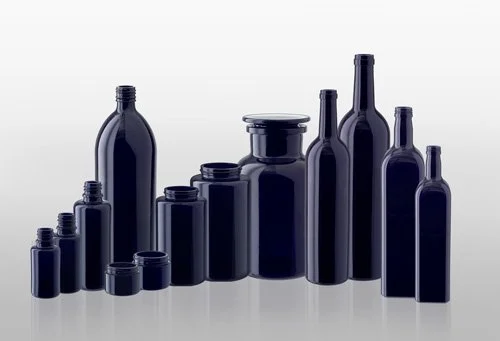
Biophotonic glass is a violet-tinted glass that filters light in a specific way:
Blocks harmful light wavelengths (the visible light spectrum) that accelerate ingredient breakdown
Allows beneficial light through, which some studies suggest can help preserve the bioenergetic properties of the ingredients stored inside
Doesn’t require added preservatives to the same degree as clear packaging, since the formula is naturally protected from one of the biggest causes of degradation
Remains non-reactive, meaning it won’t leach chemicals into the product the way certain plastics can over time
The Practical Benefits for You
Longer shelf life for active ingredients: your product performs the way it was formulated to, closer to the day you finish the bottle as it did the day you opened it
No plastic leaching or microplastic shedding: a meaningful consideration for anyone trying to minimise exposure to endocrine-disrupting chemicals and microplastic particles that can shed from plastic packaging over time, especially with repeated opening, sunlight exposure, or contact with oil-based formulas
Reusable and recyclable: glass has a far better environmental profile over its lifecycle than most plastics
Better formula integrity: especially important for oil-based and botanical products, which are more sensitive to oxidation than water-based ones
The Clil Botanicals Approach
We package our formulas in biophotonic glass because it aligns with how we think about skincare: the ingredients matter, but so does everything that touches them on the way to your skin. Choosing violet glass wasn’t just a packaging decision. It was a formulation decision. It means the African seed oils and botanical actives we source are protected from the moment they’re bottled to the moment you use them, without relying on excess preservatives or single-use plastic to get there.
If you’ve ever wondered why some natural skincare stays effective longer than others, packaging is often the overlooked reason. It’s a small design choice with an outsized impact on both product performance and environmental footprint.
Want to see biophotonic glass packaging in action? Explore our collection to find the right formula for your skin.
Where to Find Natural Skincare Products That Support Sustainable Practices
How to find natural skincare that is truly sustainable: transparent sourcing, low-impact packaging, no microplastics and fair partnerships with communities.
Quick answer: Look for skincare brands that are transparent about their sourcing, use minimal and recyclable or reusable packaging, avoid synthetic fillers and microplastics, and support the communities their ingredients come from. Sustainability in skincare spans four areas: ingredient sourcing, packaging, formulation, and social impact — and the strongest brands address all four, not just one.
Why "Natural" and "Sustainable" Aren't the Same Thing
A lot of skincare marketing uses "natural" and "sustainable" interchangeably, but they're not the same claim. A product can be made from plant-derived ingredients and still be unsustainable — if those ingredients are over-harvested, the packaging is single-use plastic, or the supply chain exploits the communities that grow them.
True sustainability in skincare means looking at the whole lifecycle of a product: where the ingredients come from, how they're processed, what they're packaged in, and who benefits along the way.
What to Actually Look For
When evaluating whether a skincare brand supports sustainable practices, check for:
Transparent, traceable sourcing — brands that name their ingredient origins and sourcing partners, not just "ethically sourced" as a vague claim
Low-impact packaging — glass over plastic, refillable or reusable containers, and packaging free of unnecessary layers
No microplastics — both as ingredients (like exfoliating microbeads) and as a byproduct of plastic packaging shedding into the product over time
Community and fair-trade sourcing — ingredients sourced through partnerships that fairly compensate the growers and communities involved, rather than extractive supply chains
Formulation efficiency — fewer, higher-quality active ingredients rather than filler-heavy formulas that require more raw material and produce more waste per use
Questions Worth Asking Before You Buy
Does the brand name specific regions or communities they source from, or only vague terms like "sustainably sourced"?
Is the packaging reusable, refillable, or made from a lower-impact material like glass?
Does the brand publish any information about its supply chain, certifications, or sourcing partnerships?
Are the formulas concentrated and effective in small amounts, or do they rely on filler ingredients that dilute both efficacy and sustainability?
Brands that can answer these clearly, with specifics rather than marketing language, tend to be the ones actually doing the work — not just claiming it.
A Note on What Your Package Looks Like When It Arrives
Here's something worth knowing before you order: your box won't be Instagram-ready. We package orders in reused cardboard, whatever sturdy materials we have on hand, and packaging that's already had a first life — not fresh, branded, color-coordinated boxes designed for an unboxing video.
That's not an oversight. It's the same principle behind the glass bottles and the sourcing partnerships, applied to the very last step of getting your order to your door. Producing brand-new packaging for every shipment, just to make it look better on camera, runs directly against everything else we do to keep our footprint small. So instead, we reuse what already exists and make sure your bottles arrive secure — even if the outside of the box has clearly lived a life before it reached you.
If you're looking for a picture-perfect reveal, this isn't going to give you one. If you're looking for a company that means what it says about sustainability, even in the parts nobody sees on camera, that's exactly the point.
The Clil Botanicals Approach
At Clil Botanicals, sustainability runs through how we source, package, and formulate. We work with African seed oil partnerships chosen for their commitment to fair, community-based sourcing. We package in biophotonic glass instead of plastic, protecting both the formula and the environment from unnecessary waste. And our formulas are built around fewer, higher-potency botanical actives rather than filler ingredients, so more of what's in the bottle is doing real work for your skin.
Sustainable skincare isn't about a single ingredient or a single claim — it's a set of choices made consistently, from sourcing to shelf. The more specific a brand can be about those choices, the more you can trust the label.
Curious how our sourcing and formulation choices come together? Explore our collection to see sustainable skincare in practice.